Everyone wants to be the answer.
Ask ChatGPT for the best project management tool, or let Google's AI Overview summarize the top HR software for startups, and a handful of companies get named. Every founder I talk to wants to be one of them. So they do the sensible thing: they invest in SEO and wait six to twelve months for the AI mentions to start rolling in.
For a lot of them, the mentions never come. Their traffic grows. Their rankings improve. They can even see their site show up in the AI's research if they dig into its sources. But when the model actually makes a recommendation, someone else gets named.
I've watched this happen enough times to believe it isn't bad luck or sloppy SEO. It's a structural misunderstanding of how AI recommendations work, and I've started calling it the Second Layer Problem.
How AI recommendations actually work
Here's the part most "AI SEO" advice skips. When an AI platform answers a recommendation question, it isn't ranking ten blue links. It's doing something closer to what a human researcher does: it gathers information about the candidates, and then it decides which ones are worth vouching for.
Those are two separate steps, and they reward completely different things. The first is retrieval: pulling together a set of businesses relevant to the question. This is heavily shaped by what lives on your website and how discoverable it is. The second is judgment: choosing which of those candidates to actually put its name behind. And that step leans on signals that mostly live off your website: what other people say about you, where you show up, and whether the story stays consistent everywhere the model looks.
Most companies pour everything into the first step and almost nothing into the second.
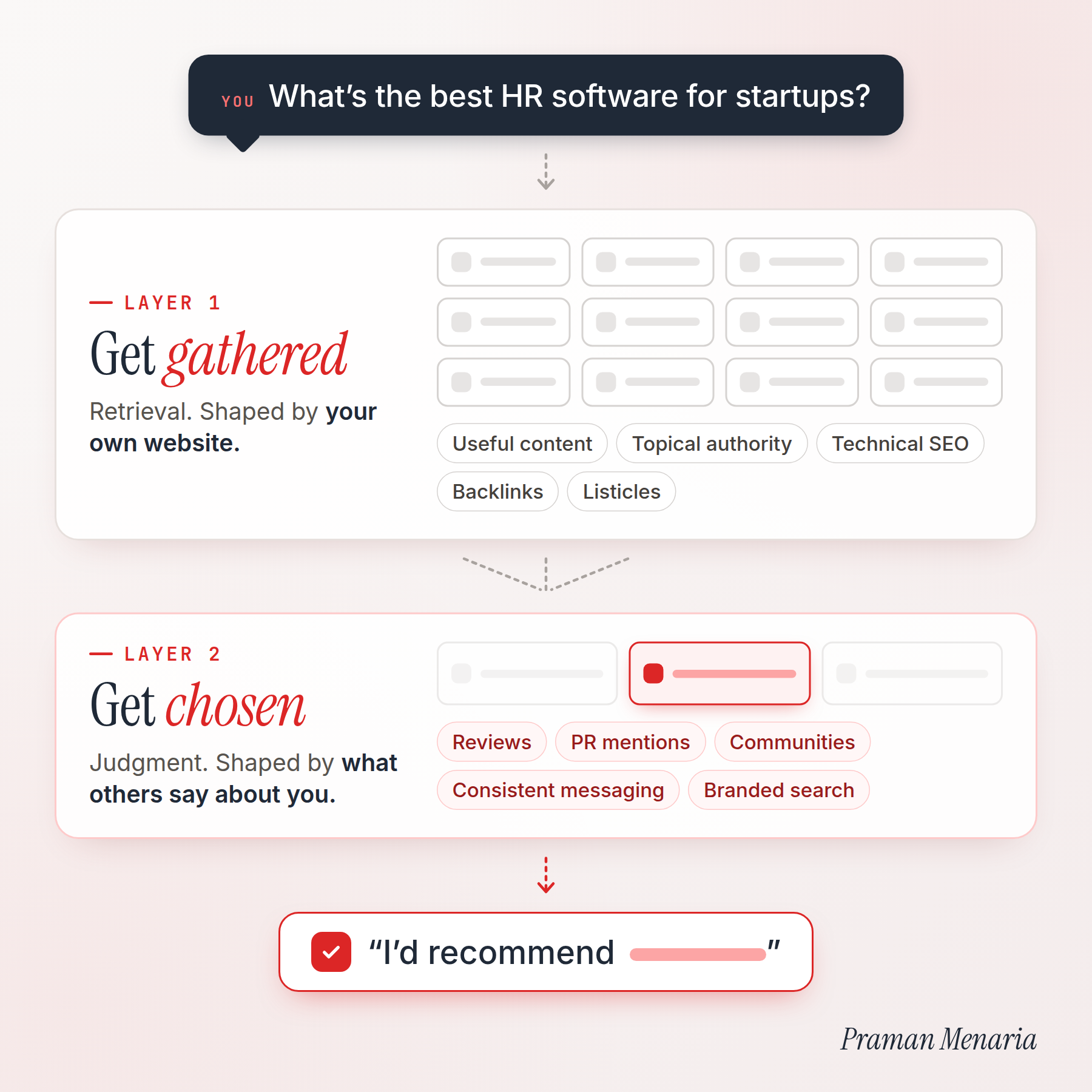
Layer 1: getting into the consideration set
This is the layer traditional SEO owns, and it still matters enormously. If the model never encounters you while it's gathering information, nothing else you do counts. Layer 1 is won with the fundamentals:
- Genuinely useful content covering the problems your buyers are researching
- Topical authority, so it's obvious what you're the expert on
- A technically sound site the crawlers can actually read
- Quality backlinks that signal you're a real, credible source
- Brand mentions in third-party listicles and "best [category]" roundups, which AI leans on heavily when it's gathering candidates
Do this well and you become gatherable. When someone asks the AI about your category, your name is in the raw material it's working from. But being in the raw material is not the same as being recommended.
Layer 2: actually getting recommended
Once the model has a handful of relevant, well-optimized candidates, it has to choose. And here it starts looking for something your own website can't credibly provide on its own: evidence that other people trust you. The signals that move Layer 2 look like this:
- A clear, consistent brand identity
- The same messaging about what you do, everywhere you appear
- Real reviews and first-hand experiences on third-party platforms the model already trusts, like G2, Capterra, Reddit, and industry directories
- Mentions in publications and PR coverage
- Active presence in the communities and forums where your buyers actually hang out
- Social proof and brand mentions scattered across the web
- A healthy volume of branded search, meaning people looking for you by name
Stack these up and they answer the one question the model is really asking before it recommends anyone: can this business actually be trusted?
What this looks like in practice
I saw this play out clearly with a YC-backed HRMS SaaS I worked with. On paper, their SEO was in great shape: the site was technically clean, the content covered the right topics, rankings were climbing, and traffic had grown from zero into the thousands. By every Layer 1 measure, they were doing the work.
But when we looked at how AI platforms actually talked about the category, the brand barely surfaced in the recommendations. It was gatherable, not recommendable.
We tried to fix it from the content side first. As an experiment, we seeded first-hand presence off the site: thoughtful posts on LinkedIn, articles on Medium, and honest participation in the Reddit threads where their buyers were already asking questions. It worked on the margins. The brand started getting cited on longer, more niche prompts. But on the head prompts, the ones every buyer actually asks, it still lost to the incumbents. The reason was almost entirely Layer 2: those top platforms had years of first-hand user reviews and experiences on trusted third-party sites, and this brand had almost none to point to. No amount of owned or seeded content could stand in for that. Same product, same website. The gap was Layer 2.
Put yourself in the model's position
If that still feels abstract, run the thought experiment. Someone asks: "What's the best HR software for startups?" The AI gathers three candidates, call them A, B and C. All three have solid content, clean sites, decent authority. Layer 1 is a wash; they're all in the consideration set.
Now it has to name one, maybe two. So it looks wider. Company A has forty G2 reviews, appears in three "best HRMS" roundups, and its founder is a recognizable voice in startup-HR communities. Company B has a beautiful website and nothing else. Which one would you vouch for if your credibility were on the line? The model makes the same call you would. Layer 1 got all three considered. Layer 2 decided the winner.
How to tell if this is your problem
A few symptoms show up again and again. You're probably sitting on a Second Layer Problem if your traffic and rankings are healthy but AI platforms rarely name you; if you can find your own pages cited as a source yet you're never the recommendation; if you have almost no third-party reviews; if searching your brand name plus "review" or "vs" returns nothing useful; or if the way you describe what you do changes depending on where you look. Any of those means the money went into Layer 1 and Layer 2 was left empty.
Why small teams get stuck here
None of this is a secret, so why do so many teams get stuck? Because of where the money goes. When an early-stage company decides to invest in organic growth, the budget almost always flows to the same places: blog writing, on-page SEO, technical fixes, a little link building. All Layer 1. It's legible, it's easy to buy as a service, and it produces a dashboard that goes up and to the right.
The Layer 2 work (building brand, earning reviews, showing up in communities, getting press, keeping messaging consistent) is slower, fuzzier, and harder to outsource. So it gets deprioritized. The result is a company that has optimized one layer beautifully, left the other one empty, and then wonders why the AI mentions never arrive.
What to do if your budget is limited
The fix isn't to abandon SEO. Layer 1 is the price of entry: skip it and you're not even in the room. The fix is to stop treating AI visibility as a pure SEO project and start funding Layer 2 in parallel, even modestly. Alongside your content, put real effort into:
- Customer stories and reviews on the third-party platforms your category trusts
- Founder-led thought leadership on the channels your buyers actually read
- Honest participation in the communities and forums where your market already talks
- A handful of digital-PR placements to earn credible, independent mentions
- Ruthlessly consistent messaging, so you describe yourself the same way everywhere
- Enough presence that people start searching for you by name
You don't need all of it at once. But you do need to be spending on both layers, not just the comfortable one.
The whole idea in one line
SEO gets you considered. Trust gets you recommended.
If every dollar you've spent on organic growth has gone into Layer 1, you haven't done anything wrong. You've just done half the job. That gap between being gathered and being recommended is the Second Layer Problem, and closing it is where the real AI-visibility work begins.